
 Türkçe
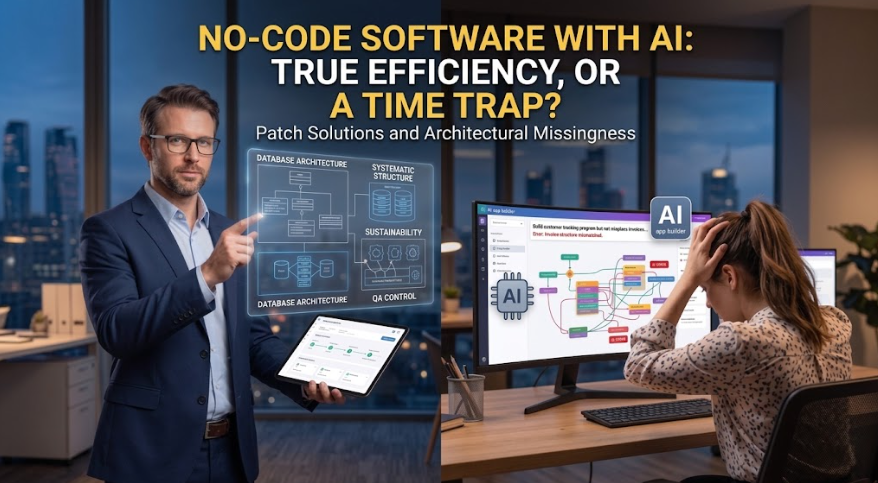
Lately, everyone seems to be repeating the same catchphrase: “You don’t need to know how to code anymore; just tell the AI, and it builds it for you.”
On paper, it sounds like we have entered a golden age of productivity. With a handful of well-crafted prompts, anyone can spin up an internal dashboard, an invoice tracking tool, or a data analysis panel in an afternoon. For a non-technical professional, it genuinely feels like acquiring a superpower.
Yet once the initial excitement settles, an uncomfortable operational reality surfaces: Are these AI-generated mini-apps genuinely driving business efficiency, or are they silently becoming a massive trap of wasted time and organizational risk?
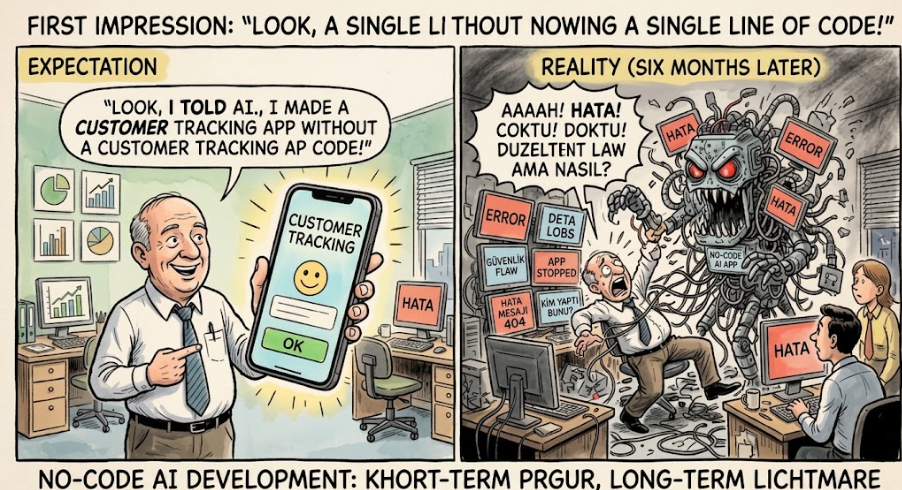
The First Impression: “Look, I Built This Without a Single Line of Code!”
It is easy to understand the appeal for business operators and department leads. For years, routine requests have lingered in IT backlogs: “We just need a simple interface to categorize incoming supplier invoices and spit out a clean report.”
What once took months of prioritization can now become a weekend experiment. The user asks, the AI generates code, the resulting errors are fed back into the chat, and by the end of the day, an interface with clickable buttons and active data inputs appears on the screen.
During the first few weeks, the outcome looks like an unqualified win:
-
A tedious manual chore is automated.
-
A functional solution is delivered without waiting on internal engineering teams.
-
Morale and a sense of ownership skyrocket.
The real test, however, begins when operational weight is applied. What happens when five people start using it concurrently, or when corrupted data enters the pipeline?

Operating Without QA: Hidden Costs and Security Blind Spots
In professional software development, engineering teams spend a substantial portion of their time not writing code, but actively trying to break it through rigorous Quality Assurance (QA).
In citizen-developer projects built through AI prompts, QA is typically reduced to a single benchmark: “I clicked the button, and it didn’t crash.”
Deploying software that has only been tested against the “happy path” introduces severe, uncalculated risks into an organization:
-
Edge-Case Failures and Silent Data Corruption: A single unexpected character, an oversized attachment, or two simultaneous writes can cause the underlying database to corrupt records without triggering a visible warning.
-
Security and Access Control Vulnerabilities: AI models prioritize delivering code that works immediately. Unless explicitly instructed and reviewed, generated code often skips input sanitization, parameter validation, and role-based permissions, inadvertently exposing confidential internal data across the organization.
-
The Illusion of Free Tools: A tool that cost “zero dollars” to write can rapidly become the most expensive asset in the company the moment it miscalculates a customer quote, misplaces a transaction record, or leaks sensitive documents.
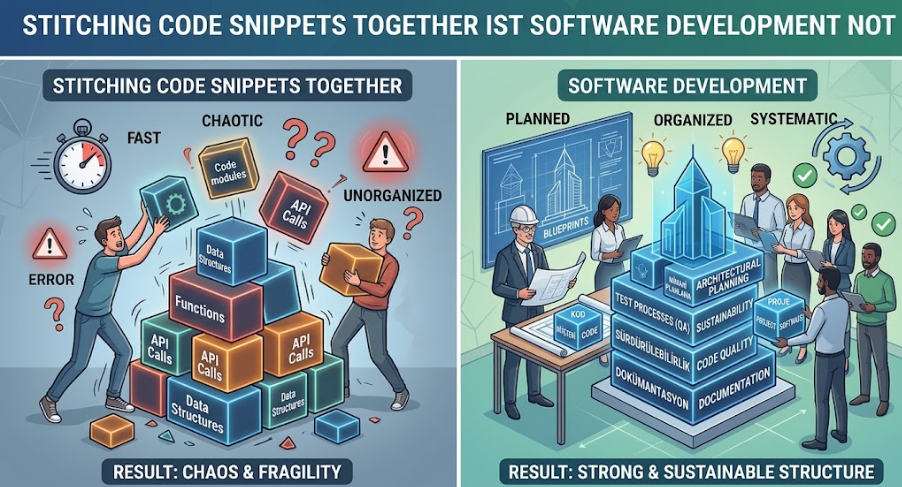
Stitching Code Together Is Not Software Engineering
Writing software is fundamentally different from assembling code snippets. Syntax is merely the raw material; architecture is what keeps the building upright.
AI has become remarkably proficient at generating functional building blocks. However, structural integrity, load-bearing architecture, and scalability still demand disciplined engineering thinking.
A robust software architecture requires:
-
Relational Data Integrity: Ensuring information is normalized, strictly defined, and consistent across its lifecycle.
-
Predictable Exception Handling: Allowing systems to fail gracefully with structured logging, rather than silently halting operations.
-
Long-Term Maintainability: Ensuring that when an API changes or a regulatory requirement shifts six months later, the entire foundation does not collapse.
When non-engineers incrementally append features using conversational prompts, the codebase quickly turns into an unmanageable patch job. Eventually, even the AI loses the context of what it wrote earlier, and fixing a minor bug inevitably breaks three unrelated functions.
Stopgap Measures and the Loss of Institutional Knowledge
The most insidious danger of these informal tools is that they provide temporary relief while creating a false sense of security.
In operations, this is the classic “band-aid solution.” The bandage covers the surface, but the underlying fracture remains untreated.
More critically, this practice erodes institutional knowledge. When an employee creates a custom tool inside their personal AI chat history and weaves it into daily operations, who actually owns that system?
-
Who maintains it when that employee leaves the company?
-
Where is the architectural documentation stored?
-
Who handles breaking changes when external libraries or APIs deprecate old versions?
Undocumented, unstandardized software trapped in personal chat logs does not build institutional capability. It fragments company workflows and burdens the business with technical debt that no one is equipped or willing to inherit.
AI has permanently lowered the barrier to writing code, and that remains an extraordinary advantage for rapid prototyping and individual experimentation. But there is a massive operational gap between a working prototype and production-ready infrastructure designed to support business-critical workflows.
Solutions built without engineering rigor, formal testing, and sustainable architecture may look like quick wins today. In reality, they are fragile stopgaps that cost far more in time, maintenance, and organizational disruption down the road. Real digital capability is not built on disposable patches; it is built on deliberate, scalable systems designed to last.
